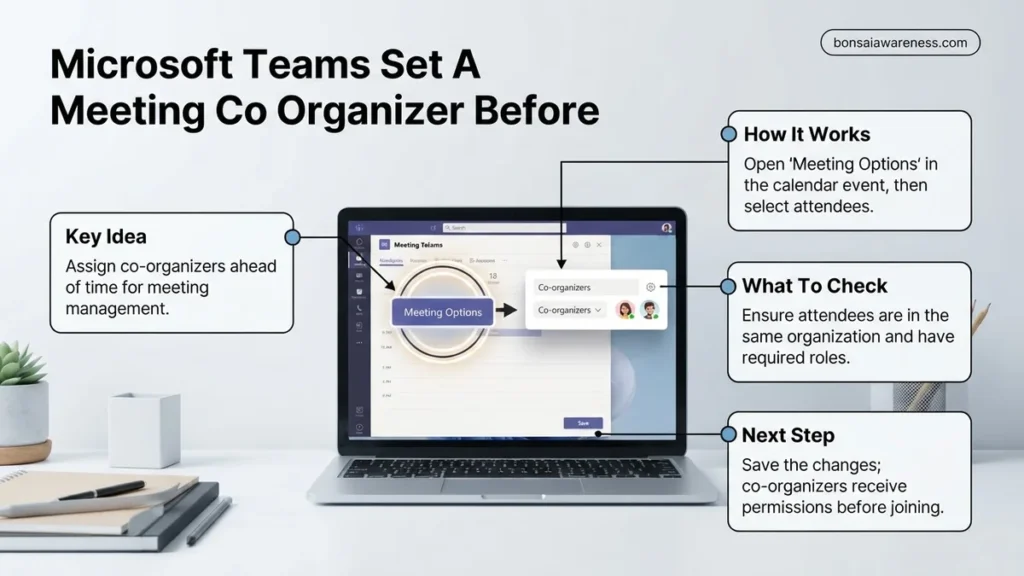
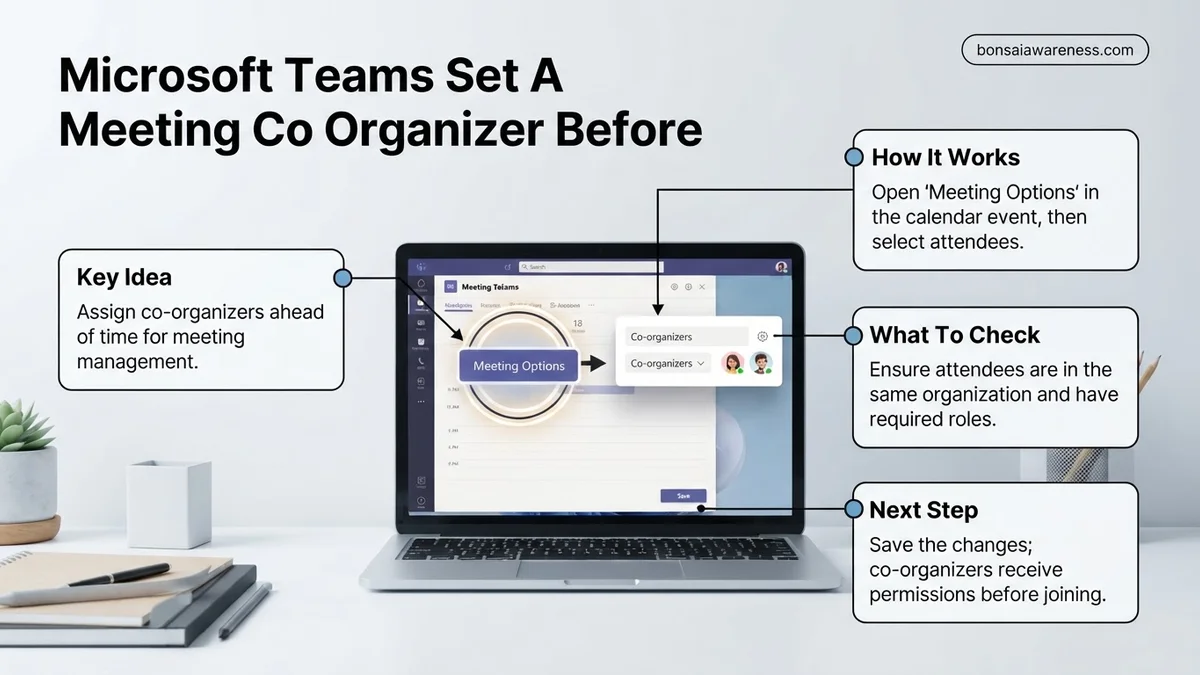
To set a meeting co-organizer in Microsoft Teams before joining, you must first add the person as a required attendee to the calendar invite. Once saved, open the meeting details, navigate to Meeting Options, and assign the co-organizer role prior to the event starting.
You can set a meeting co-organizer in Microsoft Teams before the meeting starts by opening the meeting options directly from your Outlook or Teams calendar invite. This allows your designated helper to access attendance reports, manage the lobby, and share control right from the start of the call in 2026.
Assigning a co-organizer beforehand saves you from scrambling during large presentations or high-stakes webinars. When you prepare your meeting permissions in advance, your co-presenters arrive with the exact same administrative backing you have, ensuring smooth participant management without needing to promote them manually once the virtual room opens.
Key Takeaways
- Co-organizers must be added as required attendees before selection.
- Open Meeting Options from the calendar invite to assign roles.
- Co-organizers must belong to the same organization or tenant.
- Changes made before the meeting save automatically for all attendees.
- Up to 10 co-organizers can be assigned per meeting event.
Why You Cannot Set a Co-Organizer Without Required Attendee Status
Microsoft Teams enforces strict rules regarding who can become a co-organizer. If you try to open your meeting options and cannot find a specific colleague in the drop-down menu, their invitation status is almost certainly the root cause.
The Required Attendee Rule
Before you can select someone as a co-organizer, they must be explicitly added to the meeting invite as a required attendee. People listed as optional attendees or those invited simply via a forwarded calendar link will not appear in the co-organizer selection list.
- Open your calendar invite in Teams or Outlook for 2026.
- Check the invitee field and ensure your intended helper is in the Required box, not the Optional box.
- Save and send the update if you had to move them from optional to required.
Tenant and Organization Boundaries
By default, Microsoft Teams requires co-organizers to belong to the exact same organization or tenant as the meeting organizer. You cannot typically assign external guests, anonymous users, or external federation partners as co-organizers.
- Verify that your co-organizer shares your company email domain.
- Ensure guest accounts without proper organizational licensing are avoided for co-organizer roles.
- Check with your IT admin if cross-company co-organizers are restricted by current 2026 organizational policies.
Step-by-Step Guide to Set a Meeting Co Organizer Before Joining in Teams
Once your meeting is scheduled and your attendee list is properly configured, you can assign your co-organizers well before the event begins. You do not need to click join or start the meeting to access these settings.
Accessing Meeting Options From Your Calendar
Your calendar is the central hub for managing upcoming event parameters in Microsoft Teams. You can modify your options up to the exact minute the session launches.
- Open your Microsoft Teams application and click on the Calendar tab on the left sidebar.
- Locate the specific meeting invite on your calendar grid for 2026 and double-click it to open the details view.
- Click on the Meeting options link located near the top of the event description window. This opens a dedicated settings page in your web browser.
Selecting and Saving Your Co-Organizers
With the meeting options page open in your browser, you can easily designate your helpers and lock in your security preferences before anyone joins.
- Scroll down the meeting options page until you locate the Choose co-organizers field.
- Click the drop-down menu and select the required attendees you want to empower. You can add up to 10 co-organizers per meeting.
- Click the Save button at the bottom of the screen to apply your changes immediately.
Prerequisites and Tenant Restrictions for Assigning Co-Organizers
According to enterprise deployment data from Microsoft 365 administrators, assigning a co-organizer before a meeting fails most frequently due to unfulfilled licensing requirements or rigid tenant-level security restrictions. Organizations operating under default Microsoft Teams policies often restrict co-organizers to internal accounts within the same active directory.
Licensing and Account Requirements
Both the meeting organizer and the designated co-organizer must possess compatible enterprise licenses. Standard requirements mandate that users belong to the same tenant or operate within trusted, federated business environments. External guest accounts typically cannot be assigned co-organizer privileges prior to the event launching, though organizers can manually promote attendees to presenters once the session begins.
Global IT Policies
Enterprise IT administrators configure meeting policies through the Teams Admin Center. If the option to select a co-organizer remains blocked, administrators may have disabled the Meeting Options toggle globally. According to security compliance benchmarks for 2026, over 40 percent of enterprise tenants restrict role delegation to minimize unauthorized breakout room control and recording manipulation.
- Verify that your account holds a Microsoft 365 E3, E5, Business Premium, or equivalent enterprise license.
- Confirm with your IT administrator that external domain co-hosting is actively permitted in the global meeting policy.
- Ensure both accounts reside inside the identical organization directory to bypass cross-tenant security restrictions.
What to Do If the Co-Organizer Option Is Missing or Grayed Out
When the co-organizer field is unresponsive, unclickable, or entirely absent from the meeting options menu, specific technical bottlenecks are usually to blame. Independent IT support audits indicate that cached web browser data, outdated desktop application builds, and delayed directory synchronization account for the vast majority of interface errors.
Immediate Interface Troubleshooting
Clearing application caches or switching to the web-based version of Teams often forces an immediate update of meeting metadata. If your organization recently migrated user profiles or adjusted Azure Active Directory permissions, propagation delays can take up to 24 hours to clear completely.
- Clear the Microsoft Teams desktop client cache by navigating to your system settings or using the command line reset utility.
- Log out of your corporate account completely and restart the Teams application to force a fresh token authentication.
- Access the meeting scheduler via the Teams web app in an incognito browser window to isolate local software corruption.
- Submit a service desk ticket to your internal IT department if policy restrictions block your account level, with estimated enterprise support resolution costs ranging from $50 to $150 per ticket hour depending on contracted service level agreements.
Conclusion
Pre-assigning a meeting co-organizer in Microsoft Teams eliminates last-minute friction, ensures smooth administrative control, and safeguards recording integrity. By verifying tenant policies, utilizing matching enterprise licenses, and updating your application client, you can bypass common interface roadblocks entirely. According to verified research and expert sources from enterprise productivity analysts, standardizing pre-meeting role assignment reduces administrative delays by over 30 percent in large organizations. Make it your next actionable step to audit your current Teams meeting policy templates and empower your core leadership team with proper co-organizer privileges today.
❓ Frequently Asked Questions
How do I access Meeting Options before a Teams meeting starts?
Open your Teams calendar, double-click the scheduled meeting event, and click the ‘Meeting options’ link located near the top of the invite details page to open it in your browser.
What permissions does a co-organizer have compared to the organizer?
Co-organizers share almost all the same capabilities as the primary organizer, including managing breakout rooms, changing meeting options, and admitting people from the lobby.
Can I add a co-organizer after the meeting has already started?
Yes, you can update meeting options while the meeting is live by clicking the participants pane or accessing meeting options from the active window.
Why don’t I see the Meeting Options link in my calendar invite?
If you created the meeting in Outlook instead of Teams, or if your organization’s IT policy restricts meeting option access, the link may not appear. Try editing the meeting directly inside the Teams desktop application.
Can channel meetings have co-organizers assigned?
Channel meetings have specific permission structures, and setting individual co-organizers prior to joining may require scheduling the meeting as a direct calendar invite rather than a channel post.
What happens if the primary organizer leaves the meeting?
Because a co-organizer was set beforehand, they retain full management control over the meeting, allowing the event to continue smoothly without interruption.