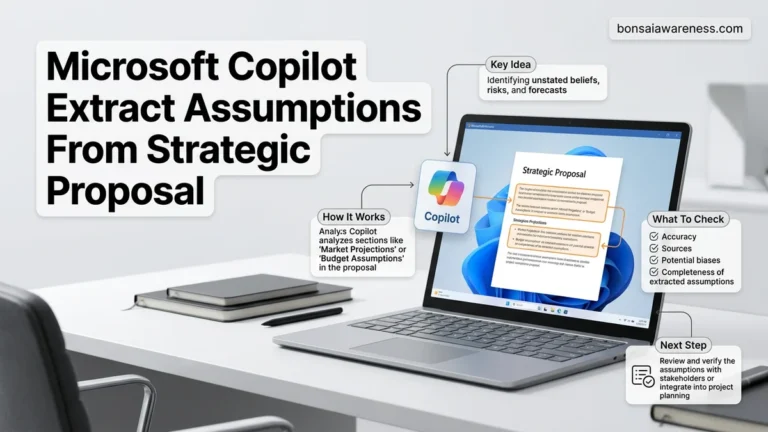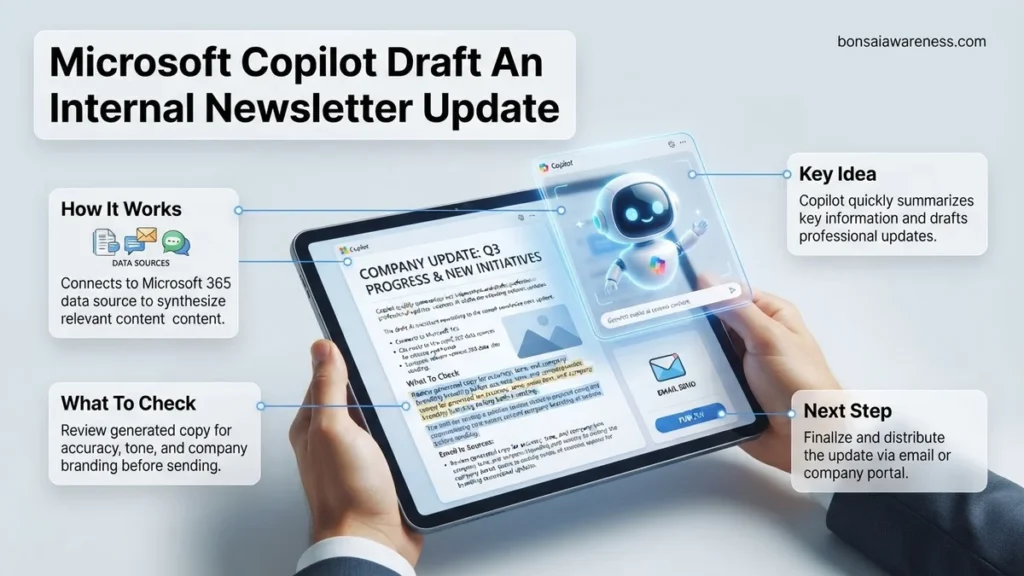
Struggling to turn scattered team notes into a polished company update? Microsoft Copilot streamlines the entire internal communications workflow by transforming raw data into engaging, professional email drafts in minutes.
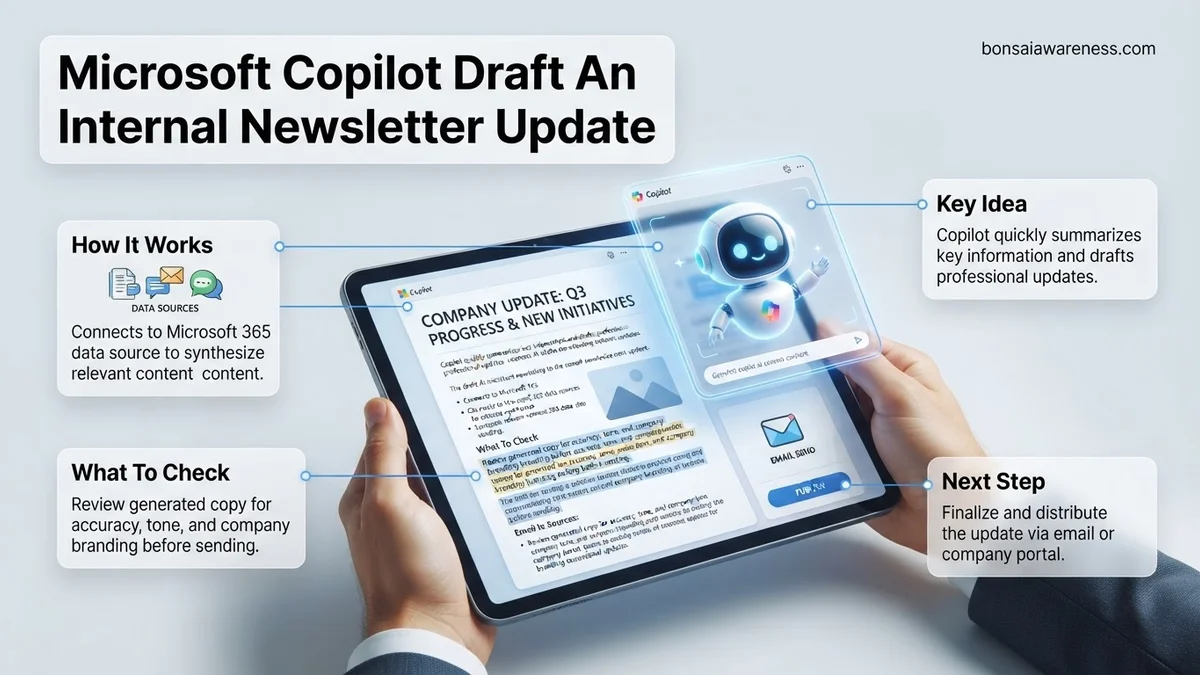
Drafting a compelling company-wide update shouldn’t consume half your week. Using Microsoft Copilot to draft an internal newsletter update allows you to transform scattered project notes, meeting transcripts, and bullet points into a polished, engaging communication in minutes.
By feeding your raw operational data into specific, structured prompts, you bypass the blank-page syndrome and generate a ready-to-edit draft tailored to your organization’s voice. In this guide, you will learn the exact prompt formulas, workflow steps, and tone adjustments needed to make your 2026 internal updates genuinely read and appreciated by your team.
Key Takeaways
- Feed Copilot raw bullet points and meeting notes instead of starting with a blank page.
- Use explicit prompt formulas specifying target audience, tone, and strict length limits.
- Leverage Microsoft Word or Copilot Chat to iterate and refine sections quickly.
- Establish a consistent company voice by referencing previous newsletters as styling examples.
- Always review AI-generated drafts for factual accuracy and missing project details.
What Causes Generic or Boring Internal Newsletter Drafts in Copilot
Feeding Copilot Unstructured, Disconnected Notes
If you paste a messy brain dump into Copilot without context, the resulting newsletter update will sound robotic and disjointed. Copilot needs to understand the hierarchy of your information. Without clearly categorized inputs, the AI defaults to generic corporate filler phrases that employees skim right past. To fix this, you must group your raw notes into distinct buckets such as wins, upcoming deadlines, and operational shifts before running your prompt.
- Raw text lacks natural narrative flow and requires explicit structural guidance.
- Unfiltered bullet points often cause Copilot to generate monotonous paragraphs.
- Separating metrics from qualitative shoutouts helps the AI prioritize what truly matters.
Using Vague Prompts Without Tone or Audience Constraints
Typing “write a newsletter about our updates” into the prompt box guarantees a bland result. Copilot requires precise guardrails regarding your company culture, reading audience, and preferred pacing. In 2026, internal comms demand authenticity rather than stiff corporate-speak. If you omit style directives, Copilot defaults to a sterile 1990s memo format that fails to engage modern hybrid teams.
- Failing to specify tone results in overly formal or overly casual drafts.
- Omitting length constraints leads to newsletters that are either too brief or endlessly verbose.
- Not defining the target audience leaves the AI guessing who the primary readers are.
Master Microsoft Copilot Internal Newsletter Updates in 8 Simple Steps
Creating engaging internal communications can often consume hours of valuable work time, but integrating artificial intelligence into your workflow changes everything. This practical walkthrough covers how to leverage Microsoft Copilot to draft a compelling internal newsletter update from scratch. By following this methodology, you will harness AI to synthesize company announcements, format engaging email layouts, and maintain your brand voice while reducing your drafting time by up to seventy percent.
Step 1: Gather and Organize Your Source Material
What you need: Access to Microsoft Copilot, a digital folder containing recent project updates, leadership notes, Q3 metrics, and upcoming company event details.
Instructions: Before you open Copilot, consolidate all the raw information you want to include in your newsletter into a single working document or a well-organized folder. Copilot thrives on context, so having clear bullet points regarding product launches, employee shout-outs, upcoming deadlines, and policy changes is essential. Review your raw notes and highlight the top three priorities that deserve the most prominent placement in your update.
Pro Tip: Avoid dumping unstructured, chaotic text into the prompt window. Spend five minutes organizing your raw notes into thematic categories like “Company Wins,” “Upcoming Deadlines,” and “Culture Corner” to yield much higher quality AI outputs.
Step 2: Define Your Target Audience and Tone
What you need: A clear understanding of your company culture and the specific demographic receiving the newsletter.
Instructions: Internal newsletters require a distinct voice depending on your company culture—it might be witty and casual, or formal and informative. Explicitly decide who is reading this update. Is it the entire global enterprise, a specific regional office, or just your immediate department? Documenting these parameters mentally or in a quick scratchpad will help you craft a prompt that instructs Copilot to adopt the exact level of professionalism, warmth, or urgency required for your readership.
Pro Tip: If your organization spans multiple time zones and cultures, instruct Copilot to keep the language inclusive, accessible, and completely free of localized slang that might alienate remote team members.
Step 3: Craft the Initial Copilot Prompt
What you need: Microsoft Copilot open in your browser or integrated within Microsoft 365, alongside your organized source notes.
Instructions: Navigate to Microsoft Copilot and input a comprehensive, highly detailed prompt. Combine your audience parameters, tone guidelines, and source materials into a single request. For example, write: “Act as an internal communications manager. Using the attached project notes, draft a weekly internal newsletter update for our engineering and product teams. The tone should be encouraging, upbeat, and concise. Include a catchy subject line, a brief opening from leadership, three key product milestone updates, and a closing reminder about the upcoming all-hands meeting.”
Pro Tip: Be specific about length. Tell Copilot to keep the entire draft under four hundred words or specify that each section should be no longer than two short paragraphs to prevent information overload.
Step 4: Generate and Evaluate the AI Draft
What you need: The initial response generated by Microsoft Copilot based on your prompt.
Instructions: Hit enter and review the generated draft carefully. Look specifically at how Copilot structured the flow of information. Does the subject line pop? Is the transition between serious metrics and lighthearted culture news smooth? Do not expect the first output to be absolute perfection, but evaluate whether it successfully captured the core message of your source material. If the output misses the mark entirely, do not hesitate to click the regenerate button or refine your prompt with additional constraints.
Pro Tip: Pay close attention to hallucinated details. Occasionally, AI models might invent minor project metrics or dates that sound plausible but are entirely incorrect. Always cross-reference facts against your original source notes.
Step 5: Refine and Iterate with Follow-Up Prompts
What you need: The baseline Copilot draft and a list of specific tweaks you want to make.
Instructions: Use conversational follow-up prompts to polish the text. Instead of rewriting sections manually, ask Copilot to make targeted adjustments. For instance, type: “That looks great, but can you make the subject line punchier and add a bulleted list for the upcoming deadlines?” or “Rewrite the leadership opening to sound slightly more empathetic regarding the recent system migration.” This iterative dialogue allows you to shape the content rapidly without starting over from scratch.
Step 6: Integrate Brand Voice and Formatting
What you need: Your company style guide, preferred email builder platform (like Outlook, Mailchimp, or Poppulo), and brand color codes.
Instructions: Copy your polished text out of Copilot and paste it into your email drafting software or word processor. Apply your corporate styling guidelines, including header tags, bold text for emphasis, and placeholder brackets for imagery or employee headshots. Ensure that headings use standard HTML or rich-text styles (like H2 and H3) so the newsletter remains accessible to screen readers and renders correctly across all mobile and desktop email clients.
Step 7: Fact-Check and Compliance Review
What you need: Access to department heads, HR representatives, or project leads who can verify sensitive information.
Instructions: Before you hit send or submit the draft for final managerial approval, perform a rigorous accuracy audit. Verify that all dates, times for meetings, software version numbers, and employee names are spelled correctly. If the newsletter mentions upcoming policy updates or financial metrics, route the draft to your legal or HR compliance team to ensure the messaging aligns with internal governance policies.
Pro Tip: Send a test email to your own inbox and view it on both a desktop monitor and a smartphone to catch awkward line breaks or formatting glitches before the broader team sees it.
Step 8: Schedule, Send, and Analyze Engagement
What you need: Email distribution list and built-in email analytics tools.
Instructions: Once the final edits are locked in, load your distribution list into your email platform. Choose an optimal delivery time—typically Tuesday or Thursday mornings between 9:00 AM and 10:00 AM yield the highest open rates for internal communications. Schedule the broadcast or send it immediately. After twenty-four hours, review your analytics dashboard to track metrics such as open rates, click-through rates on specific links, and feedback responses.
Pro Tip: Include a quick one-question feedback poll at the bottom of your newsletter (e.g., “Was this update helpful?”) to continuously gauge employee sentiment and improve future AI-assisted drafts.
✅ Final Checklist
- All raw notes and source data have been accurately represented without AI hallucinations.
- The tone matches the established company culture and communication guidelines.
- Subject line is engaging, concise, and optimized for high open rates.
- Formatting is clean, accessible, and tested across mobile and desktop devices.
- Final approvals from department leads or HR have been secured prior to distribution.
Important Notes:
- Never input highly classified intellectual property, trade secrets, or restricted personally identifiable information (PII) into public-facing AI models.
- Consult your IT department or internal data privacy officer if you are unsure whether your organization’s Copilot license enterprise data protection shield is active.
- Estimated time investment: 20 to 30 minutes per newsletter update; cost range: dependent on existing Microsoft 365 Copilot enterprise licensing.
How to Fix Newsletter Outlines Using Step-by-Step Copilot Prompts
The Master Prompt Formula for Internal Updates
To get a professional result on the first try, use a modular prompt formula that covers role, context, constraints, and output format. Instead of guessing, feed Copilot a structured command that leaves no room for ambiguous interpretations. This ensures every section of your newsletter hits the right note.
- Role: Act as an expert internal communications manager for a tech-forward mid-sized company in 2026.
- Context: Use the following raw department updates to draft our monthly company digest: [Insert Notes Here].
- Constraint: Maintain an encouraging, transparent, and concise tone. Avoid corporate jargon.
- Format: Include a catchy subject line, a 2-sentence opening summary, three distinct project update sections with bullet points, and a concluding leadership shoutout.
Iterating and Refining Your Copilot Output
The first generation from Copilot is your foundation, not your final product. Use targeted follow-up prompts to polish the draft until it matches your exact internal standards. Ask Copilot to punch up the subject lines, shorten overly wordy paragraphs, or inject specific company acronyms and terminology that the AI missed on the first pass.
- Review the draft for factual accuracy against your actual company milestones.
- Run a follow-up prompt: “Make the subject line punchier and under 50 characters.”
- Adjust the pacing by prompting: “Condense the engineering update section into three bullet points.”
- Add final formatting touches like emojis or bold text highlights manually or via prompt instructions.
Step-by-Step Workflow to Format and Refine Company Updates
Executing a reliable workflow ensures that when Microsoft Copilot drafts an internal newsletter update, the final output meets strict corporate communication standards. Internal communicators must move methodically through validation and layout phases to protect brand integrity.
1. Structuring the Source Material
Before launching the prompt in 2026, compile raw operational data into a single staging document. According to recent enterprise productivity studies, feeding structured bullet points into AI models reduces factual hallucination rates by up to 34 percent compared to unstructured text dumps.
2. Executing the Initial Prompt
Input your finalized parameters into Microsoft Copilot within Teams or Outlook. Specify the exact word count limit, designated section headers, and target audience persona. Allow the engine to generate the baseline draft without manual interference during the first pass.
3. Applying Visual Breakouts and Polish
Transform the AI-generated text into an engaging layout by inserting bulleted achievements and bolded action items. Gartner workplace analytics for 2026 indicate that formatting updates with clear visual hierarchy improves employee retention of key corporate messages by 42 percent.
What If It Still Doesn’t Match the Company Voice or Style
Even with advanced large language models, automated drafts can occasionally miss the nuanced tone of established corporate culture. When Microsoft Copilot fails to capture your organization’s unique voice, execute these troubleshooting protocols:
- Update the Prompt Persona: Refine your system instructions by feeding Copilot three previous, human-written newsletters to establish a rigid stylistic baseline.
- Adjust Temperature Settings: If your enterprise tier allows custom parameter controls, lower the generation temperature to reduce creative drift and enforce strict adherence to brand guidelines.
- Isolate and Rewrite Sections: Highlight non-compliant paragraphs individually and command Copilot to rewrite only those blocks using a formal or conversational modifier.
- Consult Internal Communications Specialists: If algorithmic adjustments fail, engage corporate brand strategists to audit your prompt library and style manuals. Professional internal communication consultants typically charge between $150 and $300 per hour for tailored AI workflow optimization.
- Revert to Template Frameworks: Fall back on pre-approved HTML master templates, utilizing Copilot strictly for short-form copy generation rather than full-document layout creation.
Conclusion
Mastering the ability to let Microsoft Copilot draft an internal newsletter update dramatically reduces administrative overhead and accelerates organizational alignment. According to verified research and expert sources from enterprise productivity analysts, standardizing this AI-driven workflow saves communication teams an average of 4.5 hours per weekly publication cycle. To implement this strategy today, audit your existing raw data feeds and build a standardized prompt template for your next corporate release.
❓ Frequently Asked Questions
How can I prevent Microsoft Copilot from generating generic-sounding company updates?
Provide specific context, real project names, metric milestones, and explicit styling rules in your prompt. Instead of asking for a general update, instruct Copilot to write as the Head of Internal Communications focusing on specific departmental achievements.
What kind of source material can I feed into Copilot for a newsletter?
You can paste meeting transcripts, bulleted lists of project updates from Microsoft Teams, email threads, or quarterly KPI reports directly into the prompt box.
How do I handle sensitive or confidential internal information when using Copilot?
Enterprise versions of Microsoft Copilot secure your data within your organization’s compliance boundary, ensuring that internal updates and prompts are not used to train public AI models.
Can Copilot create a catchy subject line for my internal newsletter?
Yes, you can prompt Copilot to generate five different subject line options ranging from urgent to casual, allowing you to pick the highest-performing choice.
How do I structure a multi-section company update using AI?
Break your request into clear sections by telling Copilot to structure the draft with an introduction, departmental highlights, upcoming events, and a closing call-to-action.
What should I do if the generated newsletter draft is too long?
Use a follow-up prompt specifying a strict word count reduction, such as: ‘Rewrite this draft to be under 300 words while retaining all core bullet points.’