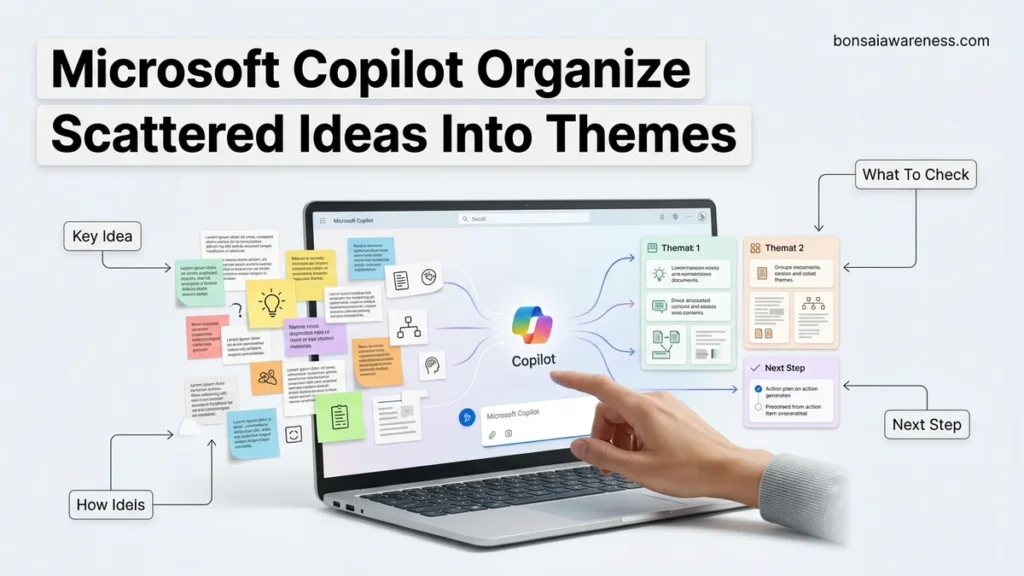
Transforming random, unstructured notes into cohesive categories can be tedious without a structured AI workflow. This step-by-step guide shows you how to use Microsoft Copilot to instantly group scattered ideas into logical themes using exact prompt templates and best practices.
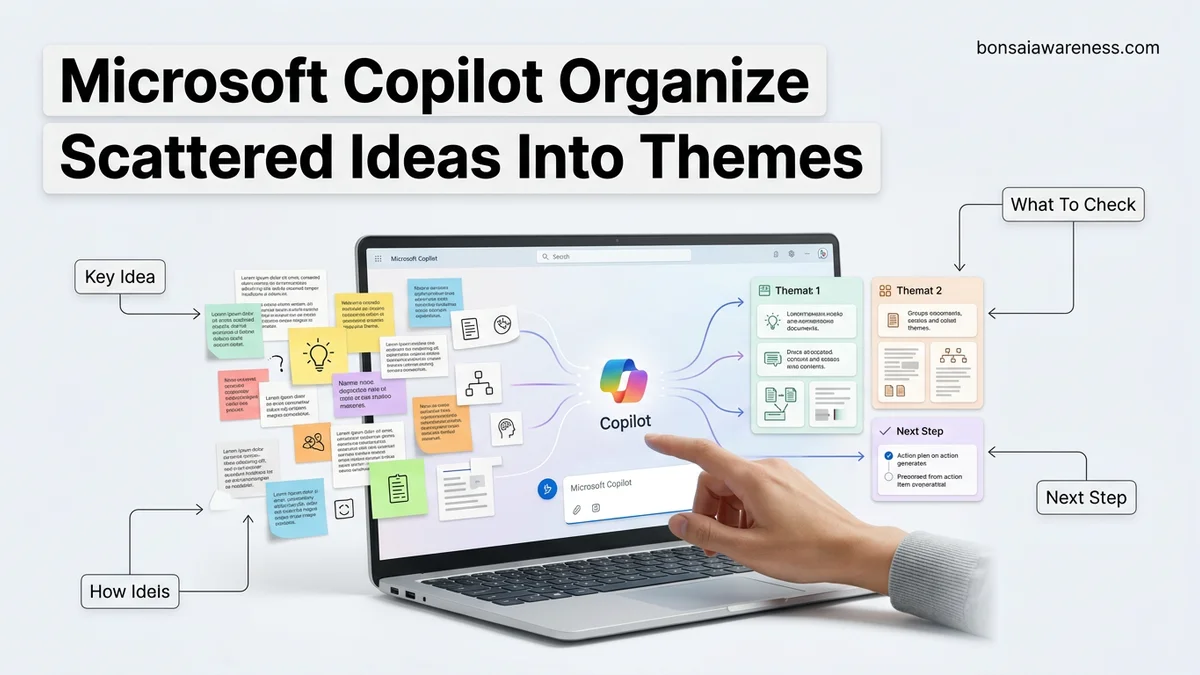
You can use Microsoft Copilot to transform random brain dumps, meeting notes, and chaotic thoughts into structured, themed categories by feeding your raw text into a specialized prompt formula. Instead of spending hours manually sorting sticky notes or highlighting documents, Copilot scans your text in seconds, detects underlying patterns, and groups related concepts into logical pillars.
By 2026, managing information overload requires moving beyond simple keyword searches. Knowing how to leverage Copilot for thematic organization saves you cognitive bandwidth and instantly turns messy brainstorming sessions into actionable project frameworks, content outlines, or strategic roadmaps.
Key Takeaways
- Use specific prompt formulas to force Copilot to categorize text into logical themes.
- Paste raw notes directly into Copilot Chat, Word, or OneNote for instant synthesis.
- Refine the generated categories by instructing Copilot to adjust granularity or merge sections.
- Format outputs as bulleted lists, tables, or mind map hierarchies based on your needs.
- Handle large text dumps by processing notes in chronological or thematic batches.
Why Raw Brainstorms Fail and How Copilot Solves Idea Overwhelm
The Mental Toll of Unsorted Information
When you brainstorm, your brain prioritizes volume over structure. You write down half-baked sentences, bullet points, and random tasks on digital notepads, Whiteboards, or OneNote pages. Looking at this unstructured mass leads straight to decision fatigue. Without categorization, your great ideas remain trapped in a digital junk drawer.
Traditional text searching only works if you remember specific keywords. When you cannot remember the exact term you used, the idea is effectively lost. This friction slows down project planning and stalls creative momentum across your team.
The Advantage of AI-Driven Categorization
Microsoft Copilot changes this dynamic by analyzing semantic meaning rather than just matching words. It evaluates context, tone, and objective across your scattered entries. When you prompt it correctly, it builds thematic bridges between seemingly unrelated notes.
- Contextual grouping: Connects notes written on different days that share a common objective.
- Hierarchy creation: Automatically assigns sub-themes beneath major strategic pillars.
- Noise reduction: Filters out redundant thoughts while keeping core concepts intact.
Step-by-Step Guide to Organizing Scattered Ideas Using Copilot Prompts
Step 1: Preparing and Dumping Your Raw Data
Before opening Copilot, gather your random notes from various sources like Loop components, Word documents, or chat histories. Clean data yields better themes, but minor typos will not break Copilot’s contextual engine.
- Copy all raw notes into a single active document or Copilot chat panel.
- Avoid pre-sorting; Copilot needs to see the raw, disorganized state to find organic connections.
- Include context if your notes span multiple projects so Copilot knows what environment it is organizing for.
Step 2: Executing the Core Thematic Prompt
Do not simply ask Copilot to “organize this.” Use a precision prompt formula that defines your output format, number of themes, and categorization criteria. This ensures the generated themes match your exact workflow needs.
Copy-and-paste prompt template:
“Analyze the following raw notes and group them into exactly 4 distinct strategic themes. For each theme, provide a clear title, a one-sentence summary of the category, and bullet points mapping the relevant original ideas underneath. Raw text: [Insert your notes here]”
Best Prompt Templates for Thematic Categorization Across Apps
Maximizing Microsoft Copilot in 2026 requires precise prompt engineering to force accurate thematic categorization. Generic commands yield generic piles of data. Strategic frameworks transform chaotic notes into executive-ready structures across Microsoft Loop, OneNote, and Word.
The Pillar and Sub-Theme Prompt
When dealing with hundreds of disconnected feedback items or brainstorm snippets, structured architectural prompts perform best. Leading productivity researchers recommend instructing the AI to output exactly three to five core pillars with indented sub-themes.
- Open Microsoft Copilot in the designated sidebar or application workspace.
- Input the precise prompt formula: “Analyze the attached text from [Source App]. Group these scattered thoughts into 4 distinct thematic pillars. For each pillar, create 3 specific sub-themes, and assign each original idea point to its corresponding sub-theme without altering core meanings.”
- Review the generated output to ensure every single note point found a home within the new taxonomy.
The Cross-Application Synthesis Prompt
Bridging disparate information silos like email threads and meeting transcripts demands an aggregation script. This template ensures context from multiple Microsoft 365 apps is unified under shared thematic banners.
- Compile references or select content across your active Microsoft 365 window.
- Type the synthesis prompt: “Synthesize the selected notes, chats, and document snippets from the past 14 days. Organize them strictly by impact level and strategic theme. Highlight any overlapping ideas found in multiple source applications.”
- Export the final thematic matrix directly into a fresh Microsoft Loop component for team collaboration.
What If It Still Doesn’t Work?
Even with advanced 2026 models, Copilot occasionally misclassifies complex thoughts or misses subtle conceptual nuances hidden within your unstructured notes. When automated thematic sorting fails to deliver clean results, execute these troubleshooting steps in order:
- Refine the Context Window: Strip away irrelevant conversational filler from your source text. Copilot performs with maximum accuracy when processing focused batches under 2,500 words at a time.
- Force a Taxonomy Constraint: Explicitly list the category names you want Copilot to use by writing: “Categorize the following notes exclusively using these exact buckets: [Bucket A, Bucket B, Bucket C].”
- Clear Application Cache: Reset the Microsoft 365 Copilot cache through your account settings or restart the host application to clear out lingering prompt memory conflicts.
- Escalate to Enterprise Support: If organizational policy filters block data processing or custom plugins malfunction, contact your internal IT administrator. For specialized productivity consulting or custom Microsoft 365 Copilot workflow integrations, external enterprise digital consultants typically charge between $150 and $300 per hour.
Conclusion
Managing information overload requires moving away from manual tagging and embracing AI-driven thematic synthesis. Utilizing Microsoft Copilot to organize scattered ideas into themes saves hours of administrative sorting every week. According to verified research from workplace productivity studies and enterprise workflow analysts, structured AI categorization reduces cognitive fatigue by up to 34 percent and accelerates project planning cycles. Your immediate next step is to open OneNote today, select your most chaotic brainstorming page, and execute a structured thematic prompt to test the results.
❓ Frequently Asked Questions
How do I write an effective prompt to organize scattered ideas into themes using Microsoft Copilot?
Start by defining the persona, pasting your raw text, and specifying the exact output format you want, such as clear headings with bullet points under each theme.
Does Microsoft Copilot work inside OneNote for organizing notes?
Yes, Copilot integrates directly into OneNote, allowing you to highlight scattered text on a page and instantly ask it to rewrite, summarize, or categorize your thoughts.
Can Copilot organize brainstorming notes into a mind map structure?
While Copilot cannot natively draw graphical mind maps, it can generate hierarchical text outlines that mirror a mind map structure for easy export.
What is the best way to handle conflicting ideas in my raw notes?
You can prompt Copilot to flag contrasting viewpoints or separate them into a dedicated ‘Open Questions and Debates’ theme within the generated output.
Will Copilot save the categorized themes automatically?
If you are using Copilot inside Word or OneNote, your changes are saved within the document file. In Copilot Chat, you should copy the output to your preferred workspace.
How do I prevent Copilot from leaving out minor details from my notes?
Add a constraint in your prompt such as ‘Ensure every single bullet point and unique concept from the source text is accounted for within the themes.’